
iMAPS Inaugural Practical Training Concludes Successfully in Qingdao
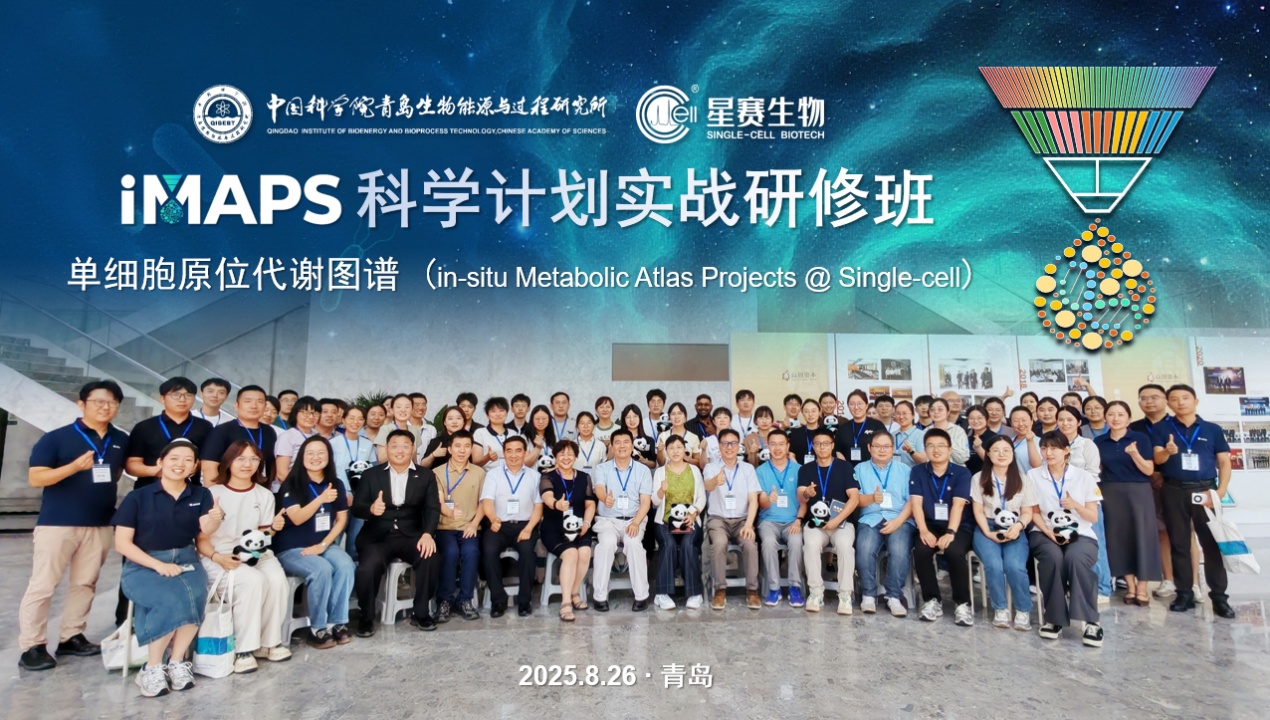
The Qingdao Institute of Bioenergy and Bioprocess Technology, Chinese Academy of Sciences (QIBEBT, CAS) hosted the first iMAPS Practical Hands-on Training Workshop on August 26, bringing together more than 70 experts and researchers from over 30 institutions across China for a full day of live demonstrations and technical exchange. The program was co-organized with Qingdao Single-Cell Biotech. Co., Ltd. and focused on the In-situ Metabolic Atlas Project @ Single-Cell (iMAPS), an international initiative to accelerate the discovery, isolation, cultivation, and application of functional microbes directly from real-world samples.
In the opening session, Prof. XU Jian, director of the Single-Cell Center at QIBEBT, outlined the scientific vision of iMAPS: using “live single-cell metabolic phenotypes” to first screen and then culture target microbes with specific in-situ metabolic activities. This strategy is designed to efficiently obtain “in-situ metabolic functional probiotics” and to answer the microbiome “6W” questions — What they are doing, Who they are, Why they matter, Wealth (value), When, and Where — at true single-cell resolution. Xu also provided an update on the rapidly expanding global iMAPS collaboration network.
Core technology modules were then presented by the instrument development team. Senior engineer ZHENG Xiaoshan introduced the Meta-Ramanomics technology suite, which uses single-cell Raman spectroscopy for label-free metabolic phenotyping and high-throughput sorting. Dr. DIAO Zhidian demonstrated the Digital Colony Picker (DCP), a platform for massively parallel single-cell cultivation, multimodal phenotype screening, and precise retrieval of desired clones. The team highlighted recent successes in areas such as high-value strain discovery for synthetic biology and targeted cultivation of environmentally relevant microbes. Prof. SUN Luyang described AI-assisted microbial image recognition and classification, showing how deep learning can deliver high-accuracy, high-throughput identification and counting of cells.
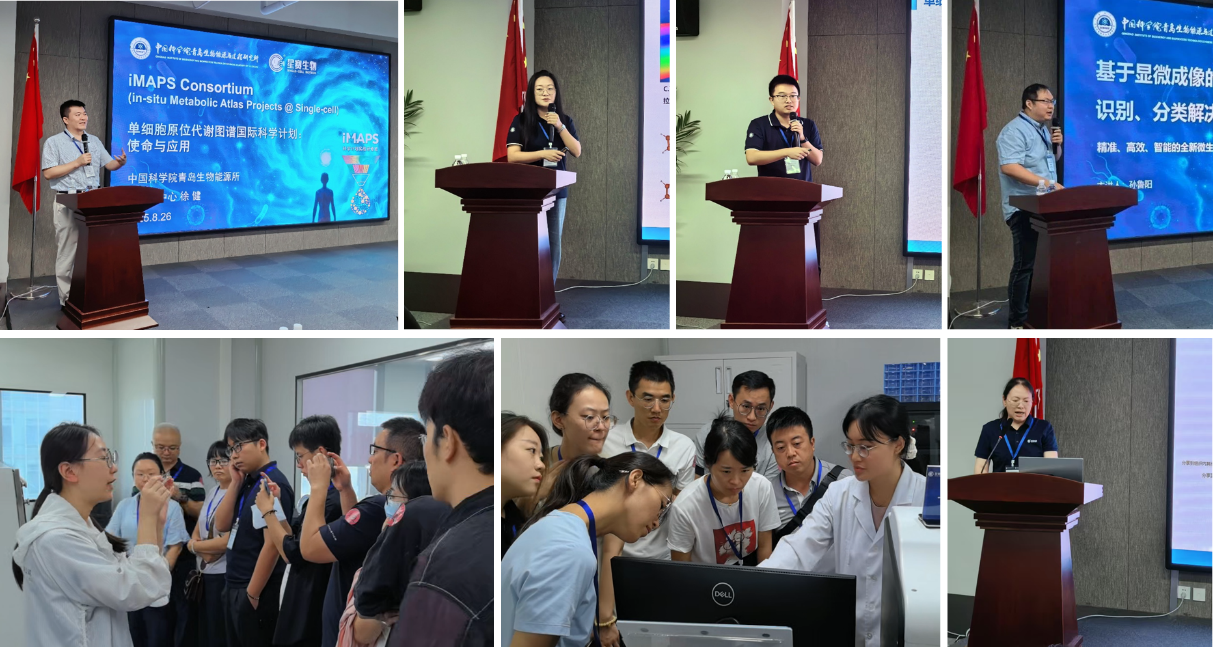
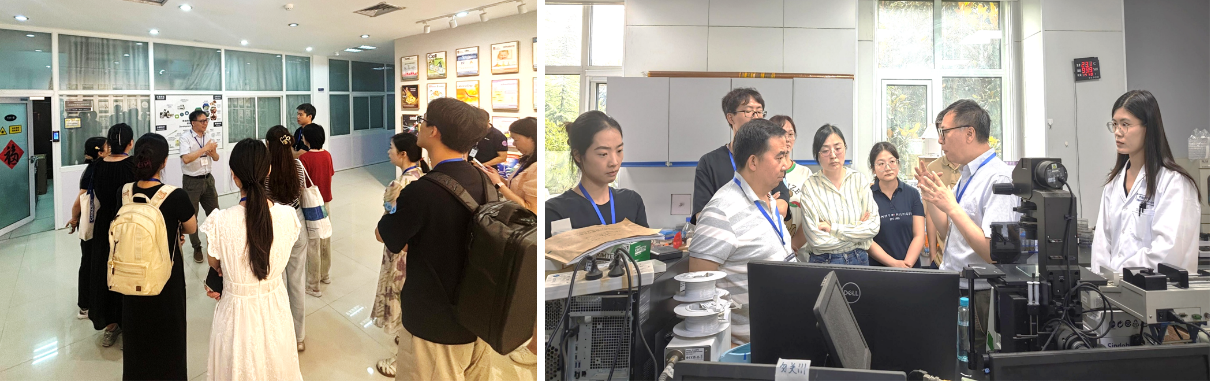
During the instrument demonstration session, participants interacted directly with a suite of original single-cell platforms developed to support iMAPS: the FlowRACS Raman flow cytometric sorter for non-invasive, label-free, high-throughput sorting of cells based on metabolic function; the RACS-Seq/Culture single-cell Raman optical tweezers system for “one-cell-per-tube” isolation followed by cultivation or sequencing; the DCP digital clone picker for high-throughput single-clone phenotyping and intelligent de-replication; and RamanAI, a cloud system for rapid Raman data analysis and modeling. In the afternoon, attendees visited the Single-Cell Center to observe additional in-house technologies such as the CAST-R rapid single-cell Raman antibiotic susceptibility testing system and a coherent anti-Stokes Raman scattering (CARS) imaging platform. On-site testing was carried out for complex microbiome samples including soil, seawater, human gut, industrial wastewater, and municipal wastewater.
Experts attending the workshop agreed that the iMAPS program and its instrument ecosystem will drive major shifts in microbial resource mining, biomanufacturing, clinical testing, and environmental governance. According to the organizers, iMAPS aims to build a globally distributed network of “metabolic sensors + strain prospectors + ecological restorers,” enabling microbial cells with valuable metabolic functions to be detected, sorted, cultured, and put to use on demand in areas such as agriculture, environmental sustainability, disease control, and human health.
