
QIBEBT Hosts iMAPS Workshop on Single-Cell, in-situ Metabolism to Unlock Yet-Uncultured Microbes
The Qingdao Institute of Bioenergy and Bioprocess Technology, Chinese Academy of Sciences (QIBEBT, CAS), together with the BISMiS 2025 organizing committee and Qingdao Single-Cell Biotech. Co., Ltd., hosted the iMAPS Workshop on October 20 in Qingdao as part of the 6th Meeting of Bergey's International Society for Microbial Systematics (BISMiS 2025), held October 17–20. The workshop focused on “single-cell in-situ metabolism–targeted isolation of yet-uncultured microbes,” and brought together more than 40 experts, including over 20 overseas participants, in areas spanning microbiology, synthetic biology, and biomanufacturing.
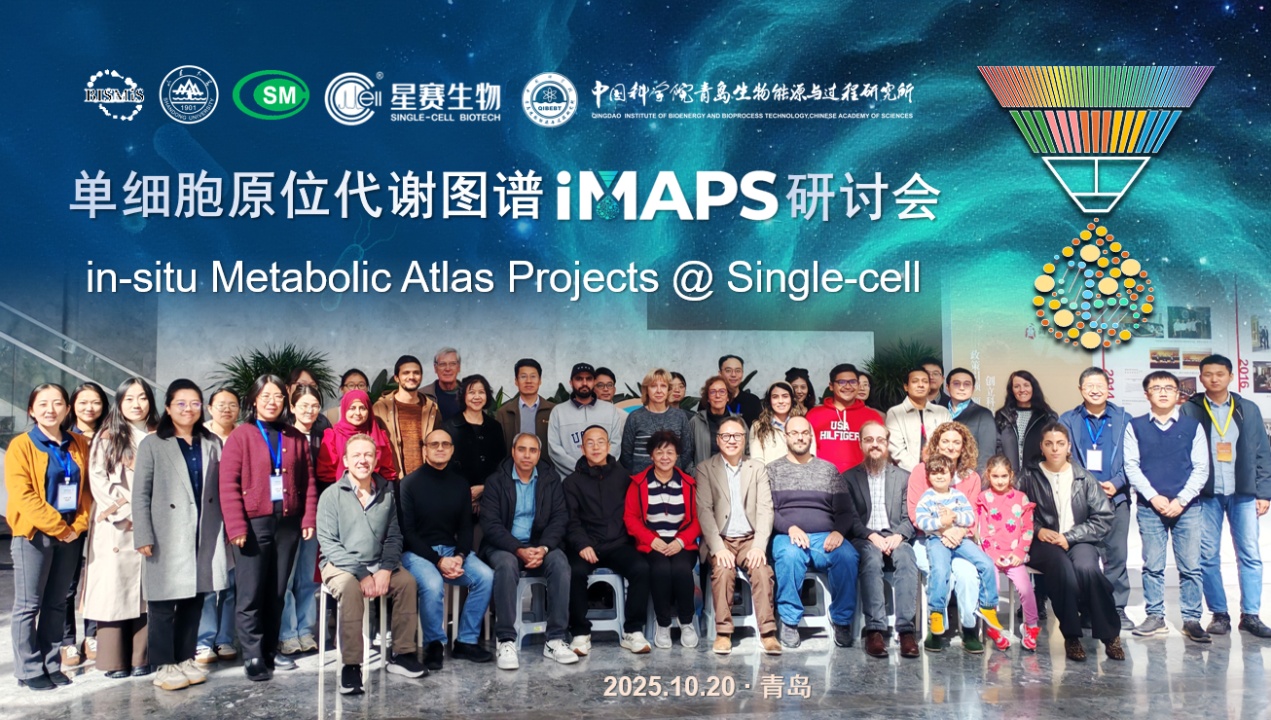
In opening remarks, Prof. MA Bo of QIBEBT highlighted three major global bottlenecks in microbiology: the vast “dark matter” of uncultured microorganisms, the difficulty of directly reading in-situ microbial function (“the functional black box”), and the gap between laboratory cultivation and real environmental phenotypes. MA stated that the In-situ Metabolic Atlas Project @ Single-Cell (iMAPS) aims to address these challenges by using single-cell in-situ metabolism as the core signal, and by linking technology development, instrument platforms, and application scenarios to move from scientific discovery to engineering and industrial deployment.
Talks at the workshop presented recent advances in the iMAPS technology suite. Dr. YIN Yifeng, Chief Scientist at the Qingdao Single-Cell Biotech., introduced single-cell Raman spectroscopy (SCRS) for analyzing metabolic activity directly in mixed microbial communities without fluorescent labels or pre-culturing. According to YIN, SCRS can generate a “metabolic fingerprint” for individual cells in a rapid, automated, and low-cost manner, supporting needs in biomanufacturing, human health, environmental monitoring, and biosafety. This work forms part of the “Meta-Ramanomics” platform, which integrates FlowRACS, RACS-Seq/Culture, and Digital Colony Picker (DCP) to link metabolic phenotyping, functional cell sorting, and live strain recovery.
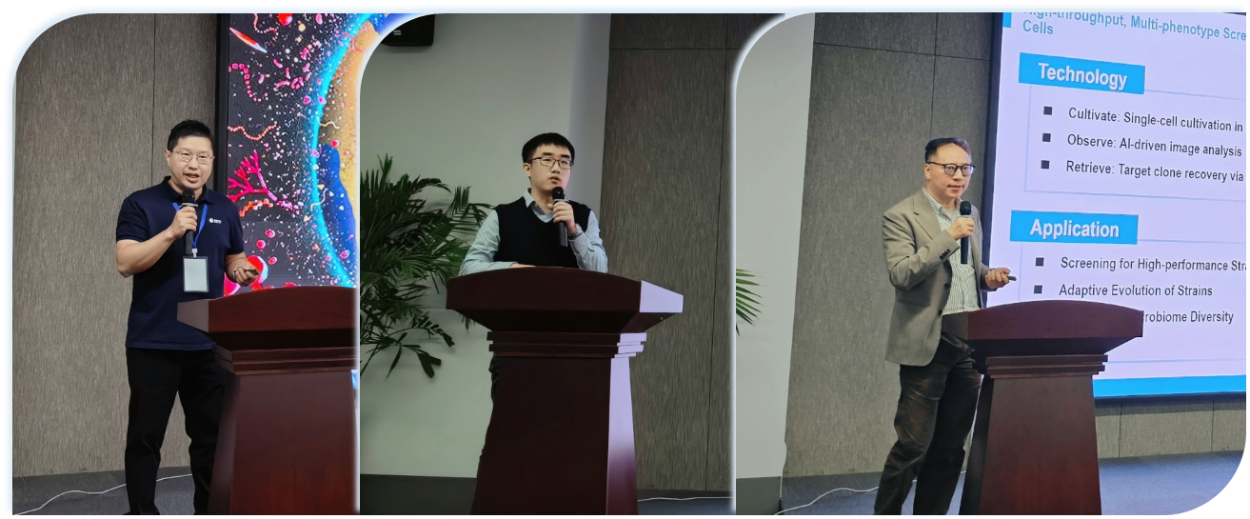
Associate Prof. WANG Xixian of QIBEBT described a high-throughput “screen first, then culture” strategy based on Raman flow cytometric sorting (FlowRACS). By combining positive dielectrophoresis deterministic lateral displacement (pDEP-DLD) with stable optical detection, FlowRACS maintains signal quality during long continuous operation and can detect and sort cells at ≥600 events per minute. The system can enrich fast-growing, stress-tolerant, or high-producing target cells from complex environmental samples or large mutagenesis libraries.
MA Bo also presented the Digital Colony Picker (DCP) as a “grow while screening” platform for multiphenotype selection at single-cell resolution. DCP uses a chip with 16,000 microchambers to physically isolate and culture individual cells, applies AI image analysis to evaluate growth, metabolism, and stress tolerance of each microclone, and then retrieves specific targets using laser-induced bubble extraction. This creates an automated “culture–identify–recover” pipeline compatible with bacteria, filamentous fungi, and mammalian cells.
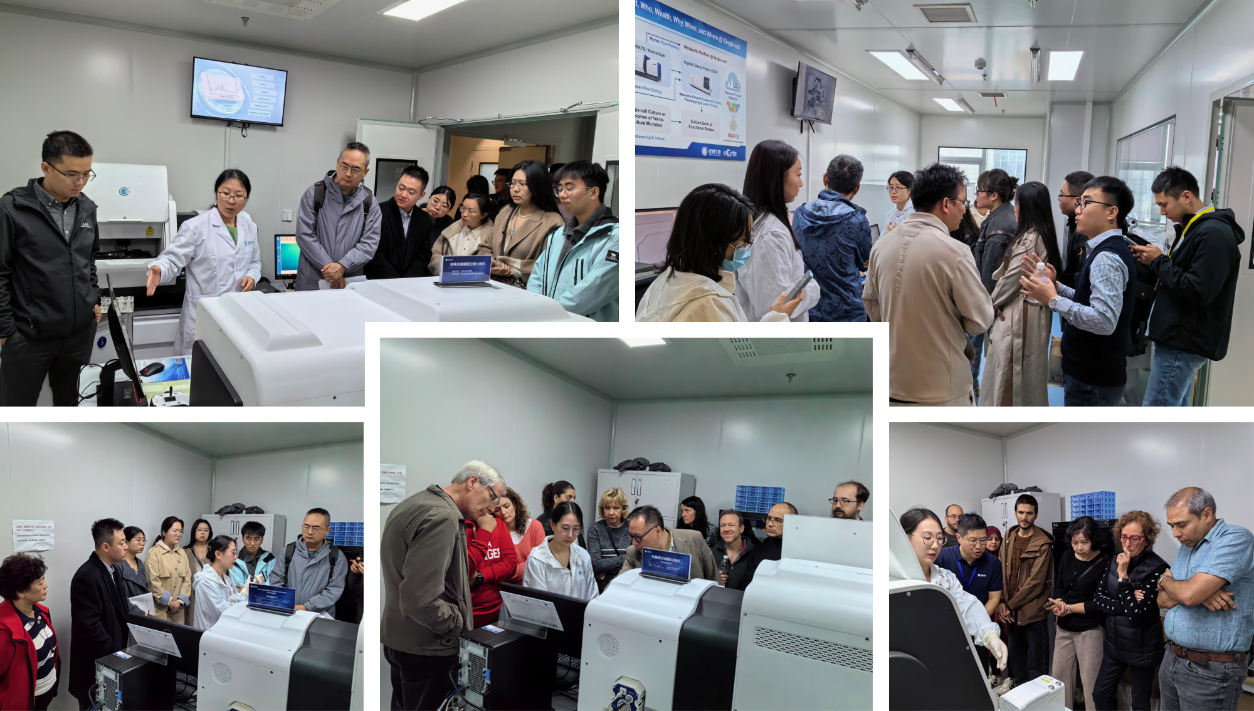
Following the talks, participants visited the iMAPS platform for live demonstrations of a full workflow: single-cell metabolic mapping, targeted cell sorting, and cultivation/validation. Discussions emphasized mining microbes from extreme environments and accelerating industrial strain development. Organizers noted that QIBEBT will continue to advance standardized methods and scenario-driven deployment of iMAPS to support biomanufacturing, environmental governance, and human health.
