
Oral iMAPS launched to chart the oral microbiome at single-cell resolution
The in-situ Metabolic Atlas Projects @ Single-cell (iMAPS) consortium has launched Oral iMAPS, a new scientific initiative aimed at creating a single-cell, in-situ metabolic atlas of the oral microbiome and advancing microbiome-based strategies for oral and systemic health. The program was officially launched on March 27 during the 104th General Session & Exhibition of the International Association for Dental, Oral, and Craniofacial Research (IADR) in San Diego.
Participating organizations include the Qingdao Institute of Bioenergy and Bioprocess Technology (QIBEBT) of the Chinese Academy of Sciences, the Faculty of Dentistry of The University of Hong Kong, the University of California San Diego (UC San Diego), West China School / Hospital of Stomatology Sichuan University, Peking University School and Hospital of Stomatology, Fudan University School of Stomatology, Qingdao Stomatology Hospital, Qingdao Women and Children's Hospital, ADA Forsyth Institute, University of Southern California, Newcastle University, Procter & Gamble, and other academic, clinical, and industrial partners.
The oral microbiome is one of the most complex microbial ecosystems in the human body. Its metabolic activity and ecological balance are closely linked to oral diseases such as dental caries and periodontitis, and are increasingly associated with systemic chronic conditions through oral-gut and oral-systemic interactions.
Oral iMAPS is designed to address long-standing technical barriers in functional microbiome research through a metabolism-targeted metaramanomics workflow that integrates live single-cell analysis, sorting, cultivation, and sequencing. The program aims to enable rapid functional profiling of oral microbiota, uncover microbial mechanisms involved in oral and systemic disease, and accelerate the discovery of beneficial oral probiotics.
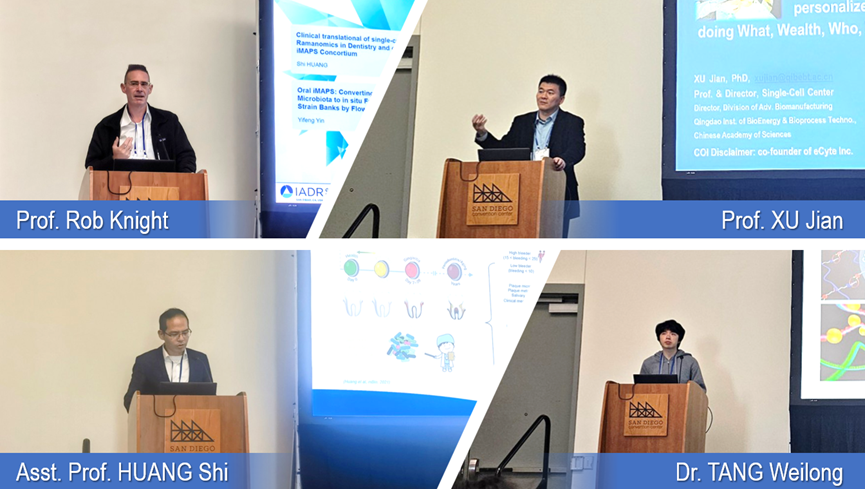
The launch symposium was chaired by Asst. Prof. HUANG Shi from The University of Hong Kong. Prof. Rob Knight of UC San Diego, a member of the U.S. National Academy of Engineering, reviewed the evolution of oral microbiome research tools and highlighted the transformative potential of metaramanomics. Prof. XU Jian from QIBEBT presented the scientific goals, technical roadmap, and collaborative framework of Oral iMAPS. Dr. TANG Weilong from The University of Hong Kong introduced probiotic-loaded supramolecular hydrogels and their potential use in adjunctive periodontitis therapy. HUANG also presented case-based applications of metaramanomics in oral medicine. Dr. YIN Yifeng, chief scientist at eCyte, Inc., presented the instrument platform supporting the initiative.
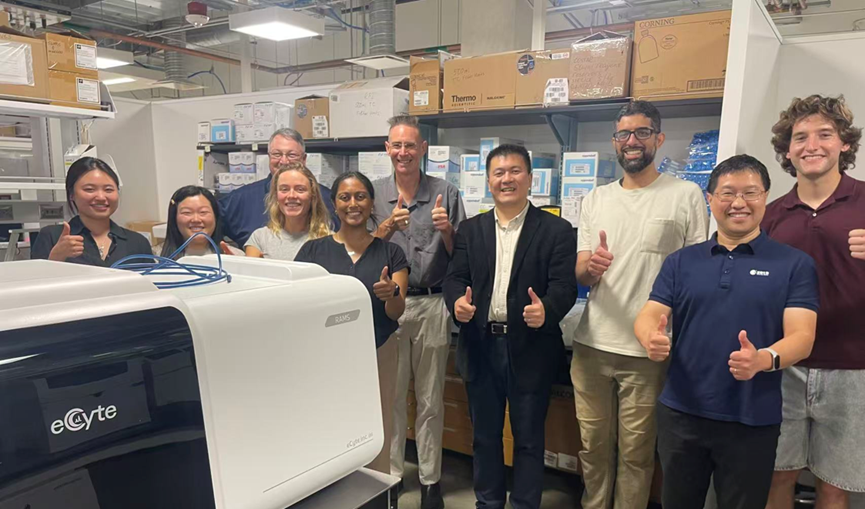
As an early milestone, the Center for Microbiome Innovation at UC San Diego has introduced the Raman-Activated Microfluidic Sorter (RAMS), jointly developed by QIBEBT and eCyte, Inc. The platform will support workflows that couple Raman-activated single-cell sorting with whole-genome sequencing for oral microbiome research.
According to the organizers, the Oral iMAPS network already includes nodes in Qingdao, Hong Kong, Chengdu, and San Diego, with further expansion underway. The broader iMAPS program is currently building a global single-cell microbiome infrastructure network across industry, agriculture, environment, health, and disease control, with more than 70 collaborative nodes under development.
